
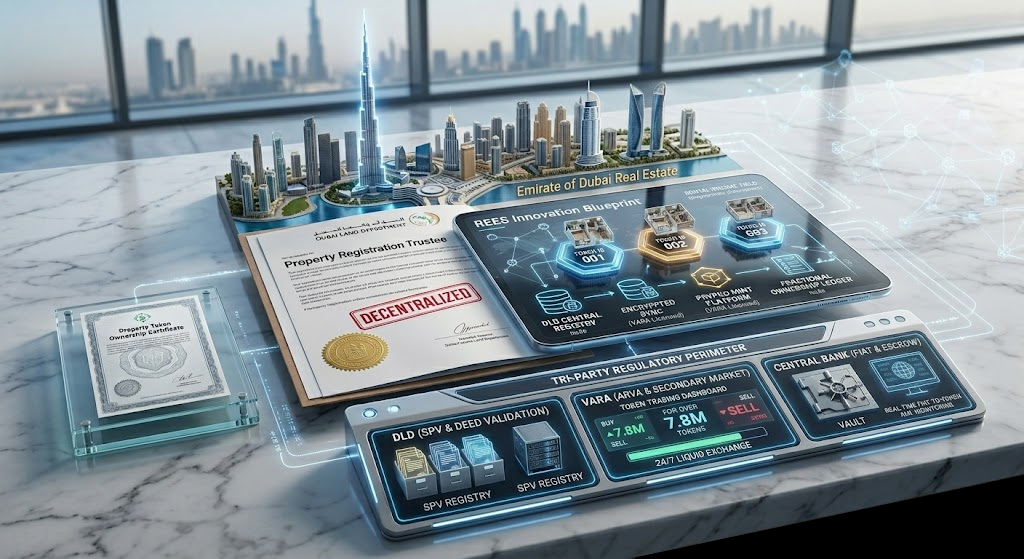
The landscape of real estate acquisition within the Emirate of Dubai is undergoing a structural paradigm shift. Driven by the ambitious mandates of the Dubai Economic Agenda D33 and the Dubai Real Estate Sector Strategy 2033, the regulatory architecture governing property transactions has moved completely away from classic, bureaucratic public offices.
Instead, the Dubai Land Department (DLD) has successfully deployed a dual-engine ecosystem to manage the immense volume of local and international capital flooding the market: the legal decentralization of administrative duties to authorized private entities, and the formal institutionalization of blockchain-backed fractional property deeds.
For institutional funds, high-net-worth individuals, and modern property owners, navigating this state-backed digital evolution requires a precise understanding of how sovereign authority, licensed trustees, and virtual asset legalities cross paths on closing day.
1. The Legal Evolution of Dubai Land Department (DLD) Bureaucracy
Historically, processing a real estate transaction in Dubai required all counterparties—buyers, sellers, and mortgage lenders—to physically present themselves at the central headquarters of the Dubai Land Department. While highly secure, this centralized model naturally created operational bottlenecks as the city’s real estate transaction volume scaled exponentially over the last two decades.
To future-proof the market, the DLD executed a deliberate strategy of administrative decentralization. Rather than outsourcing public duties to unmonitored private third parties, the government established a heavily regulated sovereign partner ecosystem. Under this framework, selected private firms are granted direct, secure access to the central DLD registry nodes to act as official extensions of the state.
Moving Away from Public Offices: The Rise of Authorised Property Registration Trustees
This structural shift led to the creation of the Property Registration Trustee system. An authorized trustee office functions as a high-end, private transaction lounge where complex real estate transfers, legal verifications, and title changes are completed under strict regulatory oversight.
By offloading the day-to-day processing of standard deeds to these certified entities, the DLD transformed property conveyance from a slow public-counter process into an agile, service-oriented experience. To discover how our premium, state-aligned infrastructure accelerates multi-asset transfers with total legal compliance, explore the VIP PLUS Homepage or review our background on our About Us page.
Securing Sovereign Data: How Private Entities Execute Official DLD Mandates
A common point of confusion for international investors is whether a private trustee office holds independent legal authority over a title deed. Legally, the answer is no; sovereign data control remains absolute.
When a transaction is initiated inside a private lounge, the trustee uses encrypted state APIs to pull real-time data from the central DLD ledger, validates the identities of the transacting parties, ensures all anti-money laundering (AML) protocols are satisfied, and inputs the new transactional data. The central DLD system reviews the cryptographic log instantly, approves the closing, and issues the official documentation. For immediate assistance with scheduling an emergency or high-value portfolio closing under this secure framework, you can connect directly with our regulatory compliance team at Contact Us.
2. The REES Innovation Blueprint: What is the Real Estate Tokenisation Project?
While the trustee system successfully streamlined traditional brick-and-mortar transactions, the DLD recognized that the next frontier of market expansion lay in digital asset innovation. Under the Real Estate Innovation Initiative (REES), the DLD formally introduced its landmark Real Estate Tokenisation Project. This project does not merely overlay speculative Web3 concepts onto real estate; it integrates distributed ledger technology directly into the sovereign land registry.
Fractional Ownership Mechanics: Investing via the Regulated PRYPCO Mint Platform
Through the launch of the government-backed PRYPCO Mint platform, the DLD proved the immense market appetite for fractionalized real estate assets. During its inaugural pilot phase, high-profile residential units sold out completely in less than two minutes, attracting hundreds of fractional investors from dozens of nationalities.
Operationally, tokenisation breaks a physical real estate asset down into highly liquid digital tokens recorded on a secure blockchain ledger (utilizing the XRP Ledger backed by Ripple Custody). Investors can acquire fractional stakes in prime properties starting from a minimum entry point of just AED 2,000.
The underlying asset is typically held within a highly structured Special Purpose Vehicle (SPV), and rental income is programmatically distributed to token holders’ digital wallets pro-rata. Crucially, before any property is listed for fractional funding, its asset value must be vetted and formally approved by official state channels to prevent artificial market inflation. To understand how these state-approved valuations safeguard investor equity across both fractional and traditional properties, see our comprehensive guide to Valuation for All Units.
The Dubai Real Estate Sector Strategy 2033: Achieving an AED 60 Billion Digital Asset Market
The tokenisation project is not a fleeting experimental pilot; it is a highly calculated macroeconomic objective. In alignment with the Dubai Real Estate Sector Strategy 2033, the government aims to scale the tokenised property market to AED 60 billion by the year 2033.
By converting rigid, illiquid brick-and-mortar assets into fractionated digital representations, the city expects tokenised transactions to account for roughly 7% of Dubai’s entire real estate market value over the next decade. This strategy significantly drives down the “illiquidity premium” that historically hampered cross-border real estate investment, opening up the market to a massive wave of global micro-investors.
3. Navigating the Legal Framework: DLD, VARA, and Central Bank Safeguards
The true brilliance of Dubai’s tokenisation framework lies in its ironclad regulatory compliance. Unlike completely decentralized, unregulated global crypto real estate initiatives, Dubai has built a strict tri-party regulatory perimeter consisting of the DLD, the Virtual Assets Regulatory Authority (VARA), and the Central Bank of the UAE.
| Regulatory Authority | Core Operational Oversight Function |
|---|---|
| Dubai Land Department (DLD) | Validates physical asset titles, registers Special Purpose Vehicles (SPVs), and issues Property Token Ownership Certificates. |
| Virtual Assets Regulatory Authority (VARA) | Licenses digital issuance platforms, monitors secondary marketplace operations, and regulates asset-referenced virtual assets (ARVA). |
| Central Bank of the UAE | Monitors fiat financial gateways, enforces strict fiat-to-token AML/CTF protocols, and ensures escrow account security. |
Token Ownership Certificates vs. Traditional Title Deeds: Analyzing the Legal Rights
From a legal standpoint, a real estate token issued under this framework is classified as a fully recognized security. When an investor buys into a tokenised asset, their legal rights are anchored directly at the land registry.
Instead of traditional deeds naming hundreds of individual co-investors, the DLD issues a specialized Property Token Ownership Certificate. This certificate records the owner simply as “Tokenholder” alongside a cryptographic TokenID that explicitly links to the investor’s verified digital wallet. This legal record is visible on both the issuance platform and the government’s official Dubai REST mobile application.
However, investors must note the structural differences: unlike traditional direct title ownership, fractional token holdings do not currently qualify investors for the AED 750,000 or AED 2 million Golden Visa residency thresholds, nor can they be leveraged using standard retail bank mortgages.
Phase Two Secondary Market Rules: Trading Asset-Referenced Virtual Assets (ARVA)
The real estate ecosystem advanced into a critical new phase with the official activation of Phase Two of the Real Estate Tokenisation Project. This phase introduced a fully operational, regulated secondary marketplace for asset-referenced virtual assets (ARVA).
Under the strict supervision of VARA, investors are no longer locked into their fractional positions until the underlying asset is completely sold. Instead, over 7.8 million real estate tokens can now be actively traded, bought, and resold 24/7 on approved secondary digital exchanges.
To maintain market stability and prevent speculative manipulation, VARA and the DLD have established rigid operational guardrails:
- Lock-In Mandate: Tokens cannot be listed on the secondary marketplace until a strict 3-month lock-in period has elapsed from the original property acquisition date.
- Price Deviation Caps: To ensure fair market value, all secondary token listings must strictly comply with a ±15% price boundary relative to the latest live real estate asset valuation provided by the DLD database.
4. Future-Proofing Asset Transactions at a Property Registration Trustee Lounge
As smart contracts and automated compliance features become baked directly into digital property tokens, the line between digital assets and traditional real estate transactions continues to blur. Technology partners are actively integrating on-chain digital ledgers directly with conventional property records, meaning that tomorrow’s large-scale institutional closings will inevitably rely heavily on a hybrid model of blockchain settlement and traditional deed validation.
Whether you are looking to acquire direct full ownership of a luxury residential asset, execute a complex corporate property transaction, or navigate the closing protocols of modern real estate, ensuring your transaction is recognized by the state requires the right expert partner.
Every single transfer, closing verification, and ownership registration must ultimately route through an authorized legal node. To discover how our specialized, high-velocity legal lounges handle both cutting-edge and conventional real estate closings with absolute regulatory precision, explore the full range of legal services at our central transaction portal: Property Sale Registration.
To learn more about the regulatory vision, compliance frameworks, and real-world execution of this historic digital asset rollout directly from the policy-makers, watch this detailed broadcast on the DLD Tokenised Real Estate Initiative. This clip features an in-depth discussion regarding the regulatory design and market access benefits of the project.