
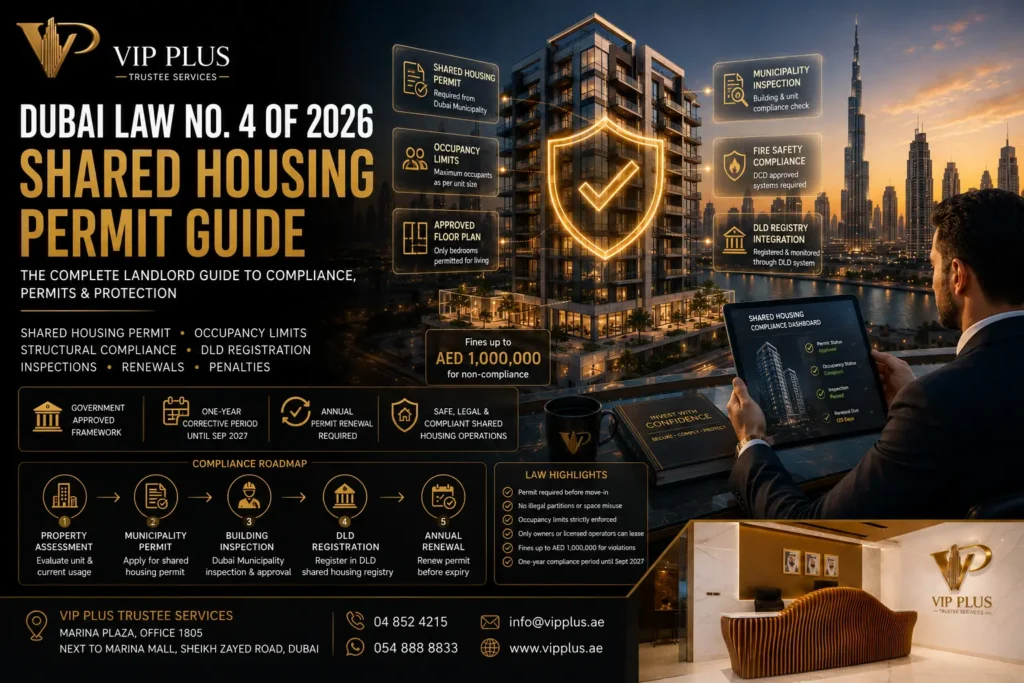
Unlicensed partitioning, unmonitored room sharing, and informal sub-letting face strict new statutory boundaries. On March 11, 2026, His Highness Sheikh Mohammed bin Rashid Al Maktoum issued a definitive regulatory framework designed to standardize shared residential living across the Emirate.
⚠️ The Statutory Compliance Timeline
Law No. (4) of 2026 officially comes into force 180 days following its publication in the Official Gazette, making the framework active in September 2026. Real estate owners and operators currently managing shared housing assets are granted a strict one-year corrective grace period ending in September 2027 to bring their entire portfolio into absolute legal alignment.
The introduction of Law No. (4) of 2026 Regulating the Management and Occupancy of Shared Housing in Dubai transitions shared residential arrangements from an unmonitored market practice into a strictly supervised, permit-based activity. Managed jointly by Dubai Municipality and the Dubai Land Department (DLD), the law establishes an integrated framework governing how multi-occupant properties are modified, leased, and registered.
The scope of the legislation is comprehensive, applying across all residential areas in Dubai, including private development zones and free zones (such as Dubai Marina, Downtown Dubai, and Jumeirah Lakes Towers). Notably, the framework explicitly excludes collective labor accommodation, which continues to be governed under separate, dedicated municipal and federal codes.
The Central Role of the DLD Registration Trustee
A critical layer of the new legislation is the mandatory integration between enforcement agencies and property registration networks. Under the new law, the Dubai Land Department is legally tasked with maintaining a centralized, electronic shared housing registry. This database links directly to Dubai Municipality’s digital permit platform to track occupancy density and technical compliance in real time.
Furthermore, the DLD is responsible for standardizing lease and management contract templates, specifying exactly what spatial allocations, landlord disclosures, and occupant tallies must be embedded within each contract. Because a Real Estate Registration Trustee office operates as an authorized vehicle for DLD contract executions, title deeds, and asset updates, the trustee desk serves as a primary compliance checkpoint. Property owners cannot legally register multi-tenant contracts without ensuring their underlying DLD registry profiles match these new parameters.
Technical and Structural Approval Parameters
Under the 2026 framework, allocating an asset for shared housing is no longer treated as a simple transactional leasing decision; it requires an engineering and safety permit. Dubai Municipality holds the authority to set exact structural parameters, maximum occupancy ceilings, and minimum space-per-resident requirements based on neighborhood infrastructure and localized population density.
While the exact implementing regulations will formally detail localized space ratios, early municipal directives and structural guidelines highlight strict pass/fail boundaries during building inspections:
| Evaluation Criterion | Compliant Standard (Permit Path) | Non-Compliant Trigger (Enforcement Risk) |
| Basic Authorization | Securing an approved municipal Shared Housing Permit prior to resident move-in. | Allocating, operating, or marketing an asset for shared occupancy without an active permit. |
| Space & Density Limits | Adhering strictly to maximum occupancy caps and minimum square footage allocations per resident. | Overcrowding spaces or exceeding the maximum occupancy thresholds assigned to the specific unit layout. |
| Permitted Living Zones | Restricting bedding and living quarters entirely to designated bedrooms verified on original structural blueprints. | Converting kitchens, bathrooms, balconies, corridors, common areas, or parking bays into sleeping zones. |
| Structural Modifications | Utilizing approved, fire-rated internal partitions authorized through official municipal planning permits. | Erecting informal gypsum board, wooden, or temporary room splitters without certified engineering approvals. |
| Safety & Infrastructure | Full operational integration with Dubai Civil Defense (DCD) fire suppression, ventilation, and electrical safety codes. | Obstructing building ventilation, installing unverified electrical routing, or bypassing central fire alarm grids. |
Permit Windows and Renewal Cycles
The law mandates a strict operational lifecycle for all authorized shared housing properties. The standard Shared Housing Permit is issued for a duration of one year and is renewable for identical terms. However, to support institutional landlords and professional co-living operators, property owners may explicitly request a specialized two-year permit, subject to advanced municipal property audits.
To prevent operational lapses or automatic contract locks, renewal applications must be submitted through the unified digital platform at least 30 days prior to the permit’s expiration date.
The Ban on Tenant Sub-Leasing
Law No. (4) of 2026 eliminates informal tenant-led subletting. A standard residential tenant is legally prohibited from renting out secondary rooms, bed spaces, or attached quarters to third parties to offset their underlying rental costs. The authority to lease shared housing units is restricted exclusively to the property owner or an establishment explicitly licensed to lease and manage real estate.
As a result, all compliant shared housing configurations must navigate one of three authorized legal paths:
1.Direct Owner Leasing:Path A.
The title deed owner directly concludes individual, compliant lease agreements with each distinct occupant, recording them inside the unified DLD digital registry.
2.Authorized Property Management:Path B.
The owner appoints a corporate establishment licensed by the DLD to manage, market, and lease the shared units on the owner’s behalf via official management contracts.
3.Licensed Master Lessees:Path C.
A corporate co-living entity corporate-leases the entire property from the asset owner, secures the municipal Shared Housing Permit, and subsequently sub-leases individual slots to residents under an approved corporate license.
Financial Realities: Penalties and Administrative Enforcement
To ensure widespread compliance and preserve the aesthetic standards of Dubai’s communities, the law backs its mandates with escalating financial and administrative penalties. Violations face a baseline fine structure ranging from AED 500 to AED 500,000 per instance, depending on the scope of the structural modification or overcrowding density.
If the exact same violation is repeated within one year from the date of the initial offense, the fine is automatically doubled, scaling up to a statutory maximum cap of AED 1,000,000.
Additional Administrative Countermeasures
Beyond monetary penalties, the Land Department and Municipality are legally empowered to impose progressive administrative remedies on non-compliant properties, including:
- Temporary suspension of the property’s shared housing operational activities for up to six months.
- The final cancellation of the Shared Housing Permit and the potential revocation of the operator’s commercial license.
- The direct disconnection of public utility services (electricity and water) pending total rectification of the underlying violation.
- The execution of immediate administrative eviction orders for any unit deemed to fail basic fire safety, structural, or public health thresholds.
Should any contractual conflicts, eviction compliance challenges, or landlord-tenant disputes arise as a direct result of these transitions, the Dubai Rental Disputes Centre (RDC) retains exclusive judicial jurisdiction to arbitrate and settle all associated legal claims.
Action Plan: Transitioning Your Portfolio to Compliance
With the compliance grace period actively moving toward the September 2027 cutoff, taking early action protects your yields and shields your real estate assets from severe municipal fines or utility lockouts. If your properties contain partitioned layouts or host multi-occupant arrangements, a formal compliance audit is vital.
At VIP PLUS Real Estate Registration Trustee, we assist landlords and corporate operators in reviewing their asset documentation, updating owner registry data, and preparing contracts for verified alignment with DLD standards. Ensuring your paperwork is flawless before submitting municipal permit applications is the safest way to preserve your investment continuity.
Frequently Asked Questions (FAQ)
Do I need a permit for shared housing in Dubai?
Yes. Under Dubai Law No. (4) of 2026, no person or corporate entity may allocate a residential property for shared housing or multi-occupant living without first obtaining an official annual Shared Housing Permit from Dubai Municipality.
What is the fine for illegal partitions or overcrowded shared housing in Dubai?
Initial fines for violating Law No. (4) of 2026 range from AED 500 to AED 500,000. If the same violation is repeated within a 12-month period, the penalty doubles up to a maximum cap of AED 1,000,000, alongside potential utility disconnections and immediate evictions.
Can a tenant sublet a room or bed space under the new 2026 law?
No. Law No. (4) of 2026 strictly prohibits standard tenants from subleasing any portion of their rented unit. The right to lease shared housing spaces is restricted exclusively to the property title deed owner or a corporate entity explicitly licensed by the DLD for property management and co-living operations.